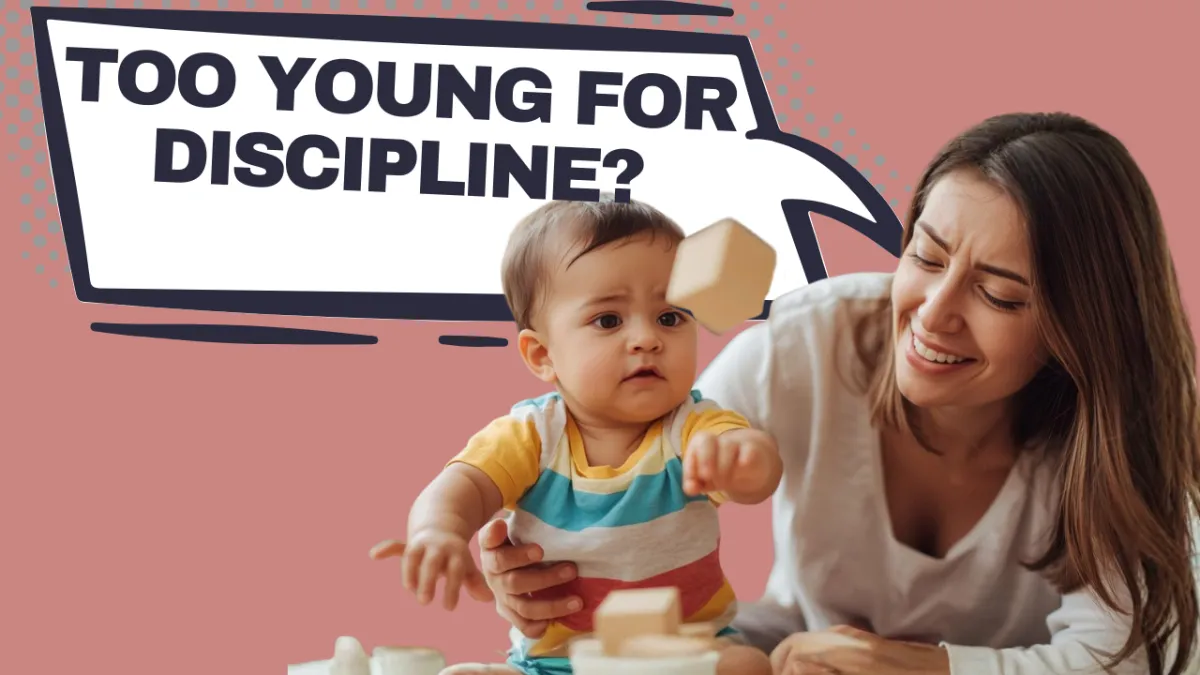
Toddler Discipline: Why Limits Must Start at Age 1


Are You Waiting Too Long to Set Boundaries?
Toddler discipline is one of those topics every parent thinks about — but most are getting the timing wrong by years.
Most parents think boundary-setting is something you start when your child is “old enough to understand.” So they wait. Three years old. Four. Five. And by the time the behavior is really a problem, it’s already been practiced for years.
Here’s what the research actually shows: healthy limits need to start at age one.
If you’ve tried setting boundaries and keep running into the same wall, or you’re just getting started and want to do this right from the beginning, this is for you. Because every week you wait is a week your child is practicing the opposite of what you’re trying to teach.
I know starting at age one sounds early. But what this actually looks like may not be what you’re imagining.
As a clinical psychologist and mom of four, I’ve spent years studying what works in real families, not just what sounds good online. And the research is consistent: children raised with both warmth and structure develop stronger emotional regulation, better behavior, and healthier relationships.
Let’s walk through what that looks like in practice.
What Boundaries Actually Look Like at Age 1
At age one, you are not issuing rules, you are teaching.
That difference is everything.
When your one-year-old crawls toward an outlet, you gently move them and say, “That’s not safe, let’s come over here.”
When they grab your hair, you calmly remove their hand: “Ouch, that hurts Mommy. Gentle.”
When they reach for your phone, you swap in a toy: “Here’s your car.”
These moments feel small, but they are building something foundational.
At this age, children learn through repetition, cause and effect, and hands-on experience. They are not too young to learn; this is exactly how they learn.
The goal is not perfect compliance. It’s understanding.
And when you stay consistent with warmth and guidance, those lessons begin to stick over time. What starts at age one becomes clearer at two, stronger at five, and more automatic by the early school years.
This is where it begins.
Why “Because I Said So” Doesn’t Work
Let’s talk about one of the most common parenting habits that quietly undermines teaching:
“Because I said so.”
It may end the moment, but it doesn’t teach anything.
When you explain the “why,” even to a very young child, you are doing something powerful. You are modeling respect. You are showing that their understanding matters.
Instead of:
“Don’t touch that.”
Try:
“We don’t touch that because it could hurt you.”
Instead of:
“Stop.”
Try:
“Come hold my hand, this part isn’t safe.”
You don’t need perfect explanations. This is about building a habit of communicating with intention.
Over time, children begin to internalize these messages, not just follow rules when you’re watching, but understand them.
And that’s the goal.
The Truth About Gentle Parenting (What’s Missing Online)
There’s a common message online that says you should avoid consequences entirely, that limits stress your child and harm your relationship.
That’s only half the picture.
Yes, harsh and punitive parenting is harmful. But so is the absence of structure.
Children without consistent limits often struggle with emotional regulation, frustration tolerance, and behavior. Why? Because structure creates safety.
When a calm, caring adult holds boundaries, it communicates:
I see you
I care about you
I will guide you
This balance of warmth and structure is what research consistently links to the best outcomes for children.
Children need opportunities to experience frustration and learn how to move through it — with support.
Setting boundaries is not harming your child.
It’s teaching resilience.
Consequences vs. Punishment: The Critical Difference
One of the most important distinctions you can understand is this:
Consequences are not punishments.
A punishment is reactive. It’s driven by frustration and often involves blame or shame. It may stop behavior in the moment, but it doesn’t teach what to do instead.
A consequence is different.
A consequence is:
Logical
Connected to the behavior
Delivered calmly
Designed to teach
For example:
If your child throws food, the consequence is that the meal ends.
Not because you’re angry, but because that’s what happens when food is thrown.
You state it once, follow through calmly, and your child learns that actions have predictable outcomes.
Over time, this builds understanding, not fear.
You Are Not Behind
Before anything else, I want you to hear this clearly:
You are not behind.
Whether you started early, or you’re starting today, this is your moment to move forward.
Parenting is not something you’re just supposed to know. It’s a skill you build.
One interaction at a time.
One boundary at a time.
One calm response at a time.
Every time you:
Redirect instead of react
Explain instead of dismiss
Hold a boundary with warmth
You are shaping who your child is becoming.
That work matters more than you think.
Ready to Take This Further?
If this gave you a new way of thinking about toddler discipline, the next step is learning how to apply it consistently in real life.
I have a live workshop where I go deeper into:
How to use consequences effectively
How boundaries fit into a complete parenting framework
How to stay consistent without power struggles
You can save your spot here:
drlindsayemmerson.com/liveworkshop
And if this resonated with you, stay connected — there’s more psychology-backed support coming your way.
You’re building something meaningful. 💛


