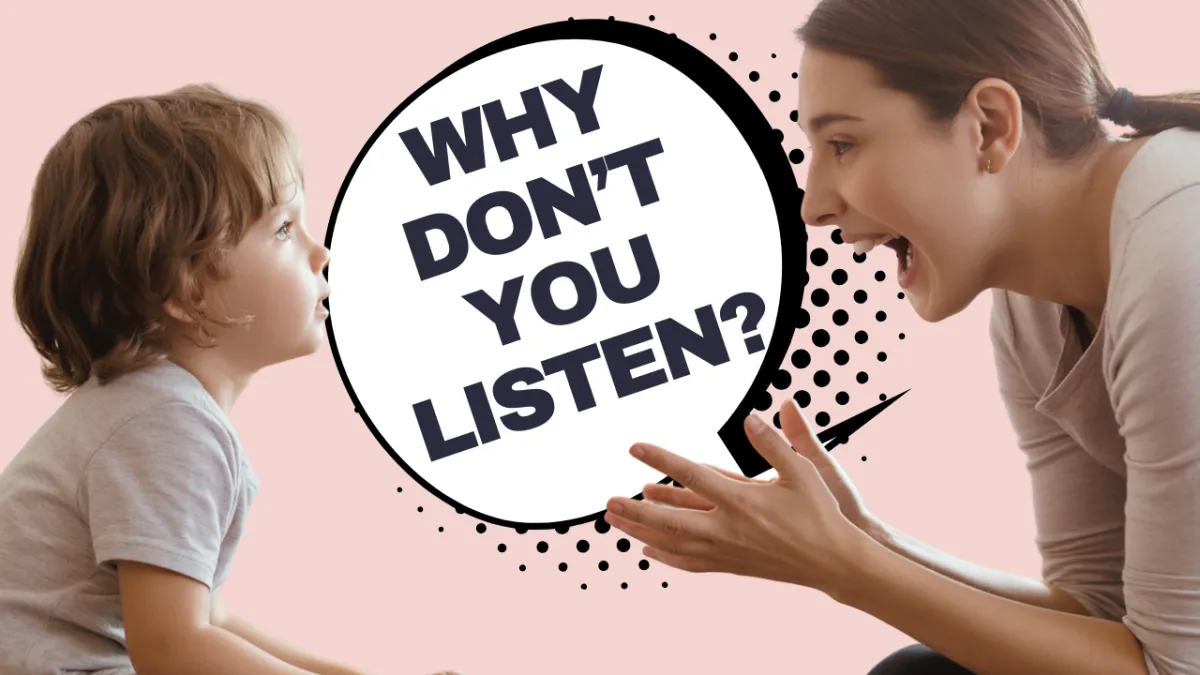
Why Kids Don't Listen (And What Actually Works)


Why kids don’t listen is one of the most common questions I get from parents—and the answer might surprise you.
Every day, parents describe the same exhausting pattern. You say something. Your child doesn’t respond. You say it again. Still nothing. By the third or fourth time, you’re either raising your voice or giving up, and neither feels good.
Here’s what I want you to understand right away:
When your child tunes you out, it’s almost never about defiance.
It’s almost always about how communication is happening.
And that’s actually really good news because communication patterns can be changed.
In this post, I’ll walk you through five research-backed reasons kids don’t listen, along with practical strategies you can start using today to help your child respond the first time without repeating yourself, yelling, or getting stuck in power struggles.
1. Your Words Have Lost Their Signal Strength
From a communication psychology perspective, there’s a concept called habituation—when something is repeated often enough, the brain starts to tune it out.
Think about a ticking clock. At first, you notice it. Then your brain decides it’s not important and filters it out.
The same thing can happen with your voice.
If your child hears the same instruction, in the same tone, at the same volume, day after day, their brain may begin to register it as background noise. Not because they’re being disrespectful—because that’s how human brains work.
What to do instead:
Change your physical position (move closer, get at eye level)
Change your phrasing (“I need your eyes for two seconds” instead of repeating the same request)
Change your timing (give instructions before they’re deeply engaged in something)
Key insight: Repetition creates noise. Variety creates attention.
2. You May Be Asking When You Should Be Stating
This one catches a lot of parents off guard.
We often phrase instructions as questions:
“Can you put your shoes on?”
“Would you mind turning off the TV?”
“Are you ready to go?”
These sound polite but they are real questions.
And young children answer them honestly.
“Can you put your shoes on?”
For a child who’s playing, the answer is often: no.
What to do instead:
Use clear, kind statements:
“Shoes on, please we’re leaving in two minutes.”
“TV off in five minutes, then it’s dinner.”
You can still be warm and respectful—but the structure should communicate what’s happening, not ask permission.
Save questions for real choices:
“Do you want to put your shoes on first or your coat?”
Clarity + warmth = cooperation.
3. Their Brain May Be Maxed Out
Children’s brains are not just smaller versions of adult brains—they function differently.
When your child is deeply engaged in an activity, their brain is fully focused. A verbal instruction from across the room is competing with a system that’s already at capacity.
This isn’t selective hearing in a behavioral sense, it’s selective attention in a neurological sense.
What to do instead:
Move closer before speaking
Get eye contact if possible
Use transition warnings:
“Five more minutes, then we clean up”
“Two minutes, then it’s time to go”
These strategies give your child’s brain time to shift gears, reducing resistance and increasing cooperation.
Think of it as giving their brain a runway, not a sudden stop.
4. The Pattern Has Taught Them You Don’t Mean It
This one is hard but important.
If your child has learned that they don’t need to respond until the fifth or sixth reminder, they will wait for the fifth or sixth reminder.
Not because they’re manipulative. Because they’ve learned what works.
Behavioral psychology shows us that behavior is shaped by outcomes. If ignoring leads to repeated requests (and eventually no follow-through), ignoring becomes the logical choice.
What to do instead:
Focus on calm, consistent follow-through.
Say it once
Mean it
Follow through
Example:
“Shoes on, please we’re leaving in two minutes.”
If two minutes pass, don’t repeat it again. Take action calmly—hand them the shoes, assist them, or follow through with a stated next step.
You don’t need to be harsh. You need to be consistent.
Consistency breaks the repetition cycle.
5. Your Emotional Tone May Be Working Against You
When frustration builds and it will your tone, body language, and energy shift.
And children are incredibly sensitive to that.
When they detect emotional intensity, their nervous system often reacts by:
Shutting down
Becoming defensive
Struggling to process language
Ironically, the more urgent or frustrated we sound, the less effective we become.
What to do instead:
Use what I call “Reset Before You Repeat.”
Before repeating yourself:
Pause
Take one breath
Drop your shoulders
Lower your voice
A calmer tone helps your child’s nervous system settle—and makes them more available to actually hear you.
Calm isn’t giving in, it’s being effective.
Final Thoughts: This Is a Pattern And Patterns Can Change
If your child isn’t listening, it doesn’t mean you’re failing—and it doesn’t mean there’s something wrong with your child.
It means there’s a communication pattern at play.
And now, you understand five of the most common ones:
Habituation (your voice blending into background noise)
Question phrasing instead of clear direction
Cognitive overload
Learned patterns from inconsistent follow-through
Emotional tone interfering with processing
You don’t need to fix everything at once.
Start with one shift this week.
Try it consistently.
Watch what changes.
Because small, intentional changes in parenting don’t just help in the moment, they transform your entire family dynamic over time.


