5 Ways to Respond When Your Kid Loses It Over Something Small


Picture this.
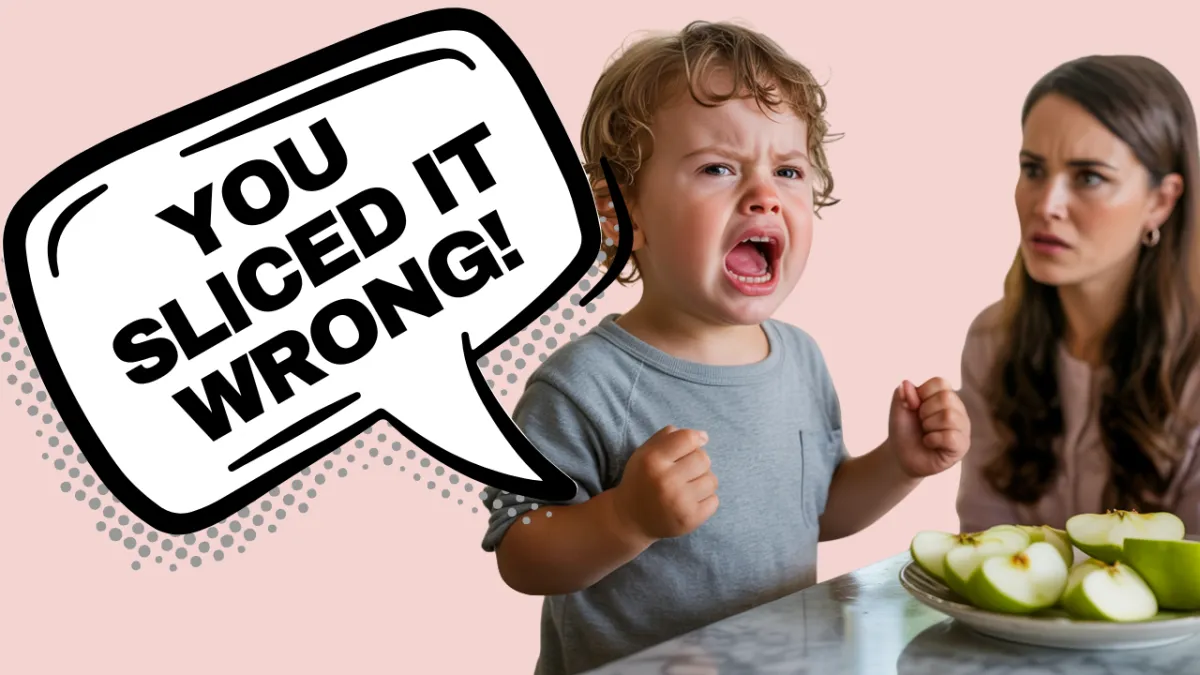
You’re in the kitchen. You slice an apple.
And from somewhere deep in the back of the house, you hear it.
That scream.
Not the “I’m hurt” scream.
The other one.
You look down at the apple in your hand and realize something terrible.
You have made a critical error.
The apple… was not supposed to be sliced.
You try pressing the pieces back together. Obviously, that doesn’t work. So you stand there, hand on your chin, staring at this apple like it personally betrayed you, wondering:
What do I do now?
Here’s the truth: you have five choices.
And the decision you make in that tiny moment — while standing in your kitchen holding a sliced apple — is the same kind of decision parents make hundreds of times a day.
Before breakfast is even finished.
Before the screen-time argument.
Before the meltdown over the wrong color cup.
Before the sandwich that was cut into rectangles instead of triangles.
Every single day we face dozens — sometimes hundreds — of these tiny parenting forks in the road.
Most of us don’t stop to analyze them. We simply react.
Which makes sense. You’re busy. You’re tired. Nobody has time to run a full psychological analysis over a piece of fruit.
But here’s what decades of research show:
the aggregate of those tiny decisions — the way you respond to the little things, day after day — is one of the most powerful influences on how your child develops emotionally and how your relationship evolves over time (Gottman et al., 1996).
So let’s walk through your five options.
Not because there’s only one “correct” response.
But because understanding what each response teaches helps you choose with intention — even when you’re running on fumes.
Option 1: The Empathetic Response
This is the response many of us hope we’ll choose on a good day.
It might sound like this:
"Oh, I’m sorry buddy. I should have asked you how you wanted your apple. That was my mistake."
Then you add a realistic option:
"Let me check if there’s another apple in the fridge. If there is, you can have it whole. If not, you can choose the slices or we can find another snack."
Simple.
But this response does several powerful things.
It models accountability
You acknowledge your mistake calmly. Children who see parents take responsibility learn that mistakes aren’t catastrophic — they’re manageable.
It offers choice within a boundary
You’re not magically producing a new apple. The situation is what it is. But your child gets agency within that reality — a key ingredient in building emotional resilience.
It validates feelings without rewarding the meltdown
Your child feels heard, but the world doesn’t instantly reorganize itself around the problem.
This is the authoritative parenting sweet spot: warmth and structure together.
On most days, when you have the emotional capacity, this is a great target response.
Option 2: The “We Don’t Waste Food” Response
We’ve all said it.
The words come out before we even fully process the moment:
"We don’t waste food in this house. You’re eating the apple."
Conversation over.
Now let’s be clear about something important.
This response will not traumatize your child.
Sometimes firm boundaries are appropriate — especially when you’re reinforcing values like avoiding waste or when you simply do not have the emotional bandwidth for negotiation.
But over time, if this becomes the default response, children may learn one of two things:
Their feelings and preferences don’t matter.
The only way to get their needs met is to escalate louder.
Neither of those outcomes is ideal.
So think of this option as a tool, not a parenting style.
Occasional firmness is healthy.
Constant dismissal is something worth noticing with curiosity — not guilt.
Option 3: The Humor Response
This one might be my personal favorite.
Imagine saying:
"Wait… did you see that? A tiny ninja just ran through here and sliced this apple before I could stop him."
Or holding the slices together and insisting:
"What do you mean? This IS a whole apple."
Humor isn’t appropriate every time.
If your child is deeply upset, jokes can feel dismissive.
But when the emotional temperature is low enough, humor can do something remarkable.
It diffuses tension, invites connection, and signals that not every inconvenience needs to become a battle.
Families who regularly share playful moments build stronger emotional bonds and greater resilience to frustration (Gottman et al., 1997).
That silly ninja story?
It becomes a tiny moment of us against the world together.
And those moments add up.
Option 4: The Withdrawal Response
This one often sounds like:
"I only help with snacks when people ask nicely. Since you yelled, there’s no snack right now."
There is a legitimate concept buried here.
Teaching children that behavior affects relationships is valuable. That’s a form of natural consequence — a core principle in behavioral psychology (Skinner, 1953).
But timing matters.
A hungry child who has just experienced disappointment is not in the emotional state to absorb a lesson about manners.
What they may learn instead is:
"When I’m upset, the people I need pull away."
That subtly erodes trust.
A more effective approach is to meet the need first, then address the behavior later:
"Earlier when you yelled at me, that didn’t feel good. Next time can you try asking differently?"
Once the nervous system is calm, the lesson can actually land.
Option 5: The Silent Fix
This is the response nobody talks about — but nearly every parent has used.
You simply grab a different snack.
No lecture. No lesson. No conversation.
You assess the situation and decide:
This hill is not worth dying on today.
And I want to say this sincerely:
Sometimes, that is the wisest choice available.
Parenting research talks about the concept of good enough parenting — children don’t need perfect responses to every moment. They need a parent who is present, reasonably consistent, and emotionally attuned (Winnicott, 1953).
Choosing your battles is not laziness.
It’s strategy.
Now, if every meltdown is immediately rewarded with a new snack, children may learn that big emotions produce quick results.
But the parent who recognizes:
"I am at a 3 out of 10 today. This is a sliced apple. I'm moving on."
That parent is practicing self-awareness.
And protecting the relationship.
The Real Lesson: It Was Never About the Apple
At the beginning of this story, it looked like the problem was a sliced apple.
But it never really was.
Every day, parents make hundreds of micro-decisions:
How to respond when a child is upset.
How to handle unreasonable demands.
How to show up when you’re tired and they need you anyway.
Individually, none of those moments feel significant.
But together, they form a pattern.
And that pattern is how your child learns:
What relationships feel like
How emotions are handled
Whether they can rely on you when things get hard
Research consistently shows that it’s the overall emotional climate of the relationship, not any single response, that shapes long-term outcomes for children (Baumrind, 1991).
So no — you don’t have to get every moment right.
You just have to know where you’re aiming.
Even something as small as a sliced apple can be an opportunity to parent with intention.
And that awareness alone is a powerful step forward.


