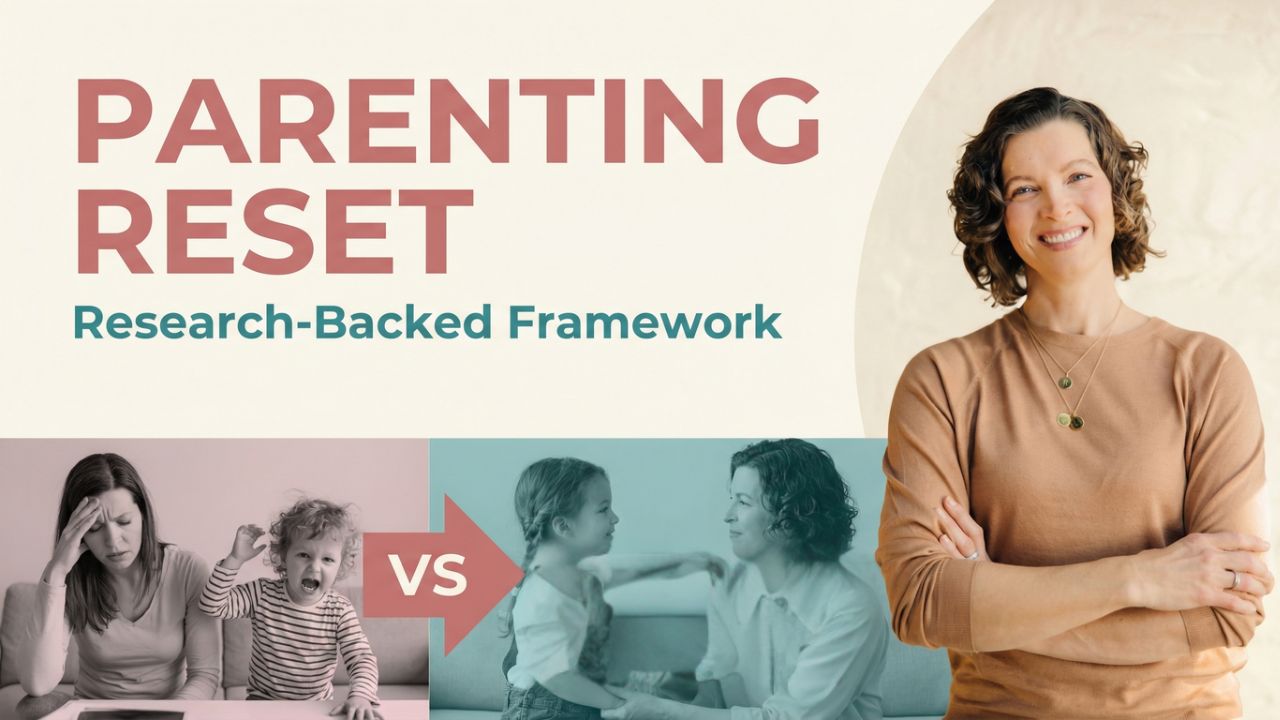
The Parenting Reset: Stop Reacting, Start Intentional Parenting


Let’s start with something honest.
Most of us didn’t get a real parenting education.
We got:
Random Instagram tips
Conflicting advice from well-meaning relatives
One-size-fits-all strategies that don’t consider development
And a lot of guilt
And then we’re expected to magically “just know” what to do when our toddler is melting down in Target or our teen is slamming their bedroom door.
I’m Dr. Lindsay Emmerson — licensed clinical psychologist, doctorate in clinical psychology, and mom of four kids ranging from 10 to 17.
I created this workshop because I saw a massive gap.
In graduate school, I studied decades of research on child development and behavior management — what actually works with kids. But when I became a parent myself, I realized something humbling:
Knowing the research and applying it at 3 a.m. with a screaming toddler are two very different things.
So I’ve spent years translating 60+ years of authoritative parenting research into practical strategies that actually work in real life.
Today, we’re resetting your parenting mindset.
Not with theory.
Not with trendy tips.
But with a framework.
First, A Quick Chaos Check-In
On a scale from 1 to 10:
1–3: Things feel mostly manageable
4–7: Some good days, some really hard days
8–10: Nearly every day feels overwhelming
Most parents I work with fall in the 6–9 range.
They’re exhausted.
They’re trying.
They love their kids deeply.
But they feel stuck between:
Yelling and regretting it
Giving in and resenting it
Or swinging between both
And here’s the truth:
It’s not that you’re failing.
It’s that most of us default to one of two extremes — and neither one produces the long-term outcomes we want.
The Two Extremes Most Parents Default To
Let’s look at what 60 years of research tells us.
In the 1960s, psychologist Diana Baumrind began studying parenting styles. That research has been replicated across cultures, family structures, and socioeconomic backgrounds for decades.
Three primary styles consistently emerge:
1. Authoritarian Parenting
High control. Low warmth.
“Because I said so.”
Strict rules. Compliance through fear. Emotional distance.
Research shows children raised this way often have:
Lower self-esteem
Higher anxiety
Increased depression
More risky teen behavior
Why? Because they learn to behave when someone is watching — but not how to regulate themselves internally.
2. Permissive Parenting
High warmth. Low boundaries.
Few limits. Avoiding conflict. Keeping the peace.
Children raised with this approach often struggle with:
Entitlement
Poor self-regulation
Higher anxiety
Because structure isn’t restrictive — it’s regulating.
And a lack of structure feels unsafe to developing brains.
Many parents don’t live fully in one camp.
Instead, they swing between them.
Lenient. Lenient. Lenient.
Then suddenly: “I SAID NOW!”
That pendulum swing is exhausting for you and confusing for your child.
So if strict doesn’t work… and permissive doesn’t work…
What does?
The Style Research Consistently Supports
Authoritative Parenting
High expectations.
High warmth.
Clear limits AND strong connection.
You guide.
You explain.
You regulate yourself.
You enforce boundaries calmly.
And the outcomes are powerful.
Children raised with authoritative parenting show:
Higher self-esteem
Stronger emotional regulation
Better social skills
Better academic performance
Lower anxiety and depression
Stronger parent-child relationships into adulthood
This isn’t opinion. It’s decades of research.
But here’s the problem:
Most parents hear “boundaries with warmth” and think…
“That sounds great — but HOW do I actually do that when my kid is melting down?”
Exactly.
Authoritative parenting isn’t just a philosophy.
It’s a skillset.
The Missing Piece: The 5 C’s Framework
Authoritative parenting requires a system.
Without one, you’ll default to:
Yelling
Giving in
Or swinging between both
That’s why I developed the 5 C’s Parenting Framework.
Think of authoritative parenting as the destination.
The 5 C’s are the GPS that get you there.
The 5 C’s of Intentional Parenting
1. Communication
Calm. Clear. Caring.
State expectations instead of asking negotiable questions.
2. Consistency
Same behavior → same response.
Predictable routines create secure kids.
3. Choices & Checkpoints
Age-appropriate autonomy.
Understanding developmental stages.
4. Consequences
Consequences teach — they don’t punish.
They guide behavior without shame.
5. Check Yourself
Parent regulation first.
You can’t teach emotional control if you’re not modeling it.
When you regulate yourself, your child feels safe.
When they feel safe, they can learn.
This framework moves you from reactive to intentional.
And today, I want to give you one powerful Level 1 strategy you can implement immediately.
The Family Mantra: A Preventive Strategy That Changes Everything
Before we jump to consequences…
Before we react to behavior…
Let me ask you something:
What are your family’s core values?
Kindness?
Respect?
Bravery?
Honesty?
Now here’s the real question:
Does your child know them?
Most parents constantly react to behavior —
“Stop hitting.”
“Don’t grab.”
“Be quiet.”
But what if instead of constantly correcting what not to do, you proactively taught who your family is?
That’s what the Family Mantra does.
What Is a Family Mantra?
A short, memorable list of words that captures your core values and behavioral expectations.
In my home, we use:
Happy.
Kind.
Respectful.
Helpful.
Gentle.
Five words. Five fingers. Ends in a high five.
It becomes identity-based parenting.
“We are a gentle family.”
“We are respectful.”
Children want to live up to identity.
This aligns with Albert Bandura’s research on modeling and observational learning. Kids internalize what they repeatedly see and hear.
Why Family Mantra Works
It shifts you from:
Reactive → Preventive
Negative correction → Positive identity
Shame → Redirection
It also supports the 80/20 rule in parenting:
Healthy families maintain:
80% neutral or positive interactions
20% corrective
The Family Mantra increases positive guidance.
Instead of:
“Stop hitting!”
You say:
“Remember, we use gentle hands.”
You’re teaching who they are — not just what they did wrong.
How to Create Your Own Family Mantra
Step 1: Identify Core Values
What do you want your child to carry into adulthood?
Step 2: Keep It Simple
Three to five concrete, age-appropriate words.
Examples:
Kind. Brave. Helpful.
Honest. Respectful. Gentle.
Make it personal:
“The Johnson 3.”
“The Martinez 5.”
Step 3: Teach It Explicitly
Hold a family meeting.
Repeat daily.
Make it part of your culture.
How to Use It
1. Proactively
Before entering a challenging situation:
“What’s our family mantra?”
2. Celebrate
“I saw you help your sister — that’s helpful.”
3. Redirect
“Pause. Which value are we missing right now?”
It becomes shorthand.
It becomes identity.
It becomes preventive discipline.
Over time, your child starts reminding YOU.
That’s when you know it’s internalized.
A Reality Check (And Some Grace)
You will forget to use it.
You will lose your cool.
You will mess up.
That’s okay.
Research shows that repair — apologizing and reconnecting — actually strengthens attachment.
Kids don’t need perfect parents.
They need parents who model growth.
Progress over perfection.
What Happens Next?
Family Mantra is a Level 1 strategy — preventive and foundational.
But what about:
Tantrums that escalate
Screen time battles
Sibling rivalry
Teen attitude
Bedtime chaos
That’s where the full 5 C’s system comes in.
Inside the Amazing Parents Club, I teach:
Weekly live Q&As
Quarterly deep-dive workshops
Access to past training
Ongoing coaching
A supportive community
Because parenting isn’t a one-time lesson.
It evolves as your child grows.
If you’re ready for deeper support and a complete framework, you can learn more at:
And whether or not you join, you can download your free Family Mantra Guide at:
drlindsayemmerson.com/mantra-download
The Parenting Reset
This is your mindset shift:
Parenting isn’t about control.
It’s not about avoiding conflict.
It’s about warmth with structure.
Boundaries with connection.
Intentional leadership instead of reactive survival.
You are already on the path.
You’re here.
You’re learning.
You’re growing.
And that alone makes you an amazing parent.
Keep going. 💛


