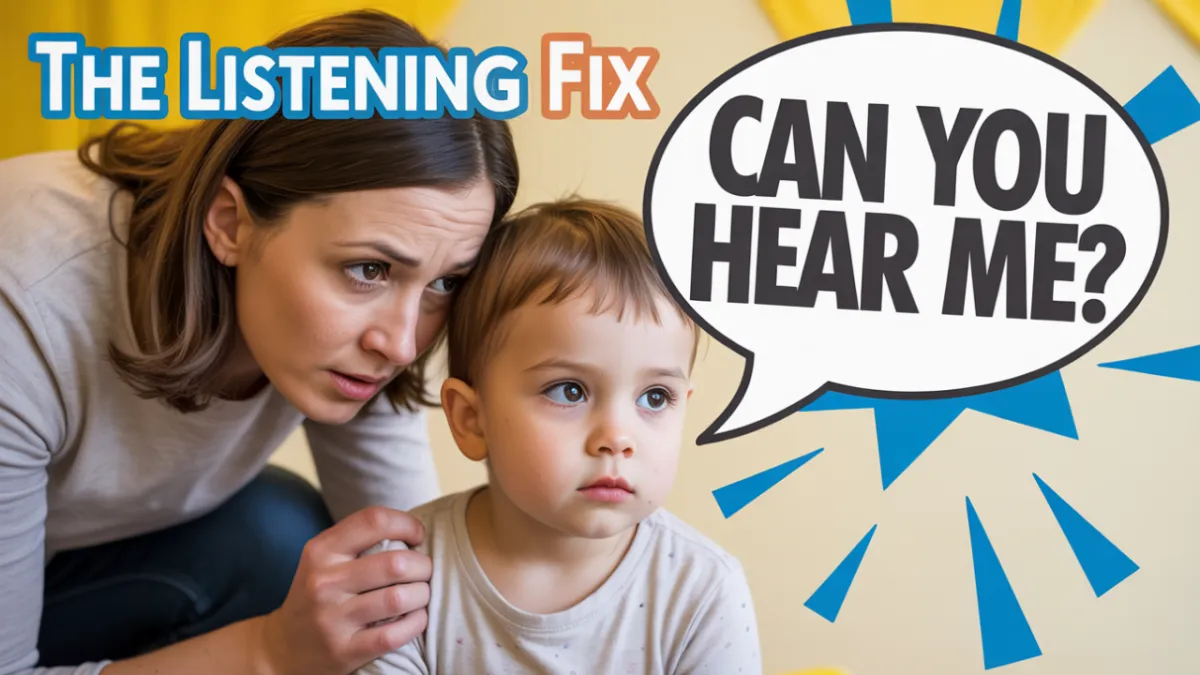
Use These 3 Words Now to Get Kids to Listen First Time


How many times have you said the same thing to your child today?
“Can you please put your shoes on?”
Five minutes later: “Can you please put your shoes on?”
Ten minutes later—frustrated and overwhelmed—
“CAN YOU PLEASE PUT YOUR SHOES ON?!”
If you’re exhausted from repeating yourself and feeling completely ignored by your own child, I need you to hear this:
It’s not that your child won’t listen.
It’s that—without realizing it—you may be teaching them not to.
The good news? There’s a simple, three-word shift that can change everything. And once you understand how it works, you can start seeing first-time listening without yelling, repeating, or feeling disrespected in your own home.
Why “Can You Please” Is Sabotaging You
Most parents are shocked when they learn this:
When you say, “Can you please put your shoes on?”
you’re not giving a direction—you’re asking a question.
And questions invite choice.
Your child’s brain hears: “Do I want to?” rather than “This is happening now.”
Parents use polite, respectful language because they want to be kind—and that intention is good. But phrases like:
“Can you please clean up?”
“Would you like to come to dinner?”
“Could you put the iPad down?”
all signal that compliance is optional.
Decades of research on authoritative parenting show that children thrive when expectations are communicated clearly and warmly—but not when those expectations are framed as negotiable. There’s a crucial difference between being kind and being unclear.
One parent shared with me:
“I thought I was being respectful by asking nicely. I didn’t realize I was teaching my son that he could just ignore me.”
Once she changed how she communicated, her child’s behavior changed too.
The Three Words That Change Everything
Here’s the shift:
Instead of asking, “Can you please…?”
state calmly and confidently:
“It’s time to…”
“It’s time to put your shoes on.”
“It’s time to clean up.”
“It’s time for dinner.”
Just three words—but they fundamentally change how your child processes your request.
Why this works:
It signals transition. Your child’s brain prepares for change instead of resisting it.
It removes negotiation. There’s no question to answer, no decision to debate.
It sounds calm and neutral. You’re sharing information, not starting a power struggle.
When you make this switch, your child hears confidence instead of uncertainty—and confidence creates cooperation.
One parent told me:
“The first morning I said ‘It’s time to get dressed’ instead of ‘Can you get dressed?’ my daughter just did it. No argument. No meltdown. I couldn’t believe it.”
That’s the power of clarity.
The Follow-Through That Makes It Stick
Here’s the part that matters most:
“It’s time to” only works if you follow through.
If you say it once and hope it happens, you’re back where you started.
Here’s the framework:
State the expectation once, calmly.
“It’s time to put your shoes on.”Pause for 5–10 seconds.
Give your child time to process and respond.Offer calm support, not a threat.
“Shoes on now, or I’ll help you.”
This gives your child a choice within your boundary: do it independently, or receive help.
And then—this is key—you follow through.
If they don’t comply, you calmly help them. No lecture. No anger. No repeating yourself. Just consistent action that matches your words.
One parent explained:
“I helped my son with his shoes three times. By the fourth day, he just did it when I said ‘It’s time.’ He learned I meant it.”
That’s how children learn to take your words seriously.
Why Your Tone Matters as Much as Your Words
The phrase “It’s time to” only works when your tone supports it.
If your voice sounds pleading, your child hears uncertainty.
If it sounds sharp or frustrated, they feel threatened.
What works best is a tone that is calm, clear, and caring.
Try this simple practice:
Say, “It’s time to get ready for bed,” three different ways.
With frustration — notice how aggressive it sounds.
With uncertainty — notice how easy it is to ignore.
With calm confidence — steady, warm, matter-of-fact.
That third tone is the one that builds cooperation.
Children read your tone more than your words. When your voice communicates, “I’m calm and I mean what I say,” they’re far more likely to comply.
One parent told me:
“I recorded myself and realized I sounded desperate. Once I practiced calm confidence, my kids responded completely differently.”
Your tone teaches your child whether to trust your leadership.
What to Do When They Still Don’t Listen
Even with great communication, children will still test limits. That’s normal.
If “It’s time to” doesn’t work immediately, check these three things:
1. Timing
Children need transition warnings.
Try: “In five minutes, it’s time to leave.”
Then follow with: “It’s time to leave now.”
2. Physical needs
Hunger, thirst, fatigue, pain, heat, or being cooped up inside can completely derail regulation. Address the need first.
3. Consistency
This strategy works best as part of a bigger framework—clear communication paired with consistency, appropriate choices, and calm follow-through.
And be patient with yourself. If you’ve been asking questions for years, it takes time for both you and your child to adjust.
One parent shared:
“After two weeks of consistently saying ‘It’s time to,’ my kids just started listening. It became the new normal.”
The Payoff
You’re not a bad parent because your child doesn’t listen the first time.
You’ve simply been using communication patterns that accidentally taught them they didn’t have to.
Now you know better.
“It’s time to” isn’t just three words—it’s a shift into calm, confident leadership.
It reduces power struggles.
It builds trust.
And it teaches your child that your words matter.
Imagine mornings without repeated reminders.
Bedtimes that flow instead of explode.
A home where you’re heard—without raising your voice.
You deserve that.
And your child deserves a parent who leads with clarity and calm confidence.
You’ve got this. 💛


