The New Way to Be a Father in 2026. Start Now.


Your kid just talked back to you.
Or refused to do what you asked.
Or broke a rule you’ve repeated a hundred times.
You feel that heat rising—the anger, the urge to raise your voice, maybe even the impulse to grab their shoulder a little too hard.
You know you’re about to lose it.
But what if there were a completely different way to handle these moments—one that actually teaches respect instead of fear?
I’m Dr. Lindsay Emmerson, and this is the fathering approach backed by over 60 years of psychology research.
The New Model of Fatherhood
Something powerful is shifting in fatherhood, and you can feel it.
More and more dads are rejecting the old model—the distant, authoritarian father who ruled through intimidation and control.
They’re stepping into a new role: still strong, still a leader—but also connected, emotionally present, and deeply trusted by their kids.
This isn’t about becoming “soft.”
It’s not about letting kids walk all over you or giving up on discipline.
It’s about becoming the kind of father your children will actually want a relationship with when they’re grown—the one they’ll call for advice, trust with their struggles, and remember with gratitude instead of fear.
And if you’re thinking, “But my dad was strict and I turned out fine,” pause for a moment.
Did you turn out fine—or did you just learn to survive?
Did your relationship with your father teach you how to be emotionally healthy, or did it teach you to suppress your feelings and avoid vulnerability?
The way many of us were fathered doesn’t have to be the way we father our children.
Let’s talk about the new model—what I call amazing parenting, or authoritative fathering—and why it changes everything.
Why the Old Model Doesn’t Work
If your father ruled through fear, you’re not alone. For decades, most homes operated under the authoritarian model—strict, controlling, emotionally distant, and quick to anger.
Yes, that approach often produced “obedient” kids.
But the research is clear: obedience isn’t the same as well-being.
Children of authoritarian parents are more likely to:
Have lower self-esteem and weaker decision-making skills
Struggle with anxiety, depression, and emotional regulation as teens and adults
Develop poor social skills and difficulty forming healthy relationships
Engage in riskier behaviors, because they learned to fear punishment—not to self-regulate
Perform worse academically, despite strict expectations
And perhaps the hardest truth: children of authoritarian fathers often grow up to repeat the cycle. Some become authoritarian themselves, while others swing to the opposite extreme—becoming permissive, afraid to set any boundaries at all.
The result?
Kids who appear disciplined but feel disconnected.
Children who obey, but carry quiet fear instead of inner confidence.
The old model creates obedience—but it breaks connection.
What “Amazing Fathering” Looks Like
The modern father embraces a model called authoritative parenting—what I call amazing parenting.
This model blends warmth with structure.
It’s high expectations paired with high support.
Firm boundaries wrapped in emotional safety.
And it’s backed by decades of research.
Studies show that involved, authoritative fathers:
Reduce behavior problems in boys and emotional issues in girls (Sarkadi et al., 2007)
Raise children who are 43% more likely to earn A’s and 33% less likely to repeat a grade
Improve their children’s emotional regulation, social skills, and cognitive development (Cabrera et al., 2018)
Strengthen self-confidence and long-term mental health
The takeaway?
You don’t have to be perfect. You just have to be consistently present in a caring, steady way.
Real strength isn’t control.
It’s composure.
It’s staying calm when you’re angry.
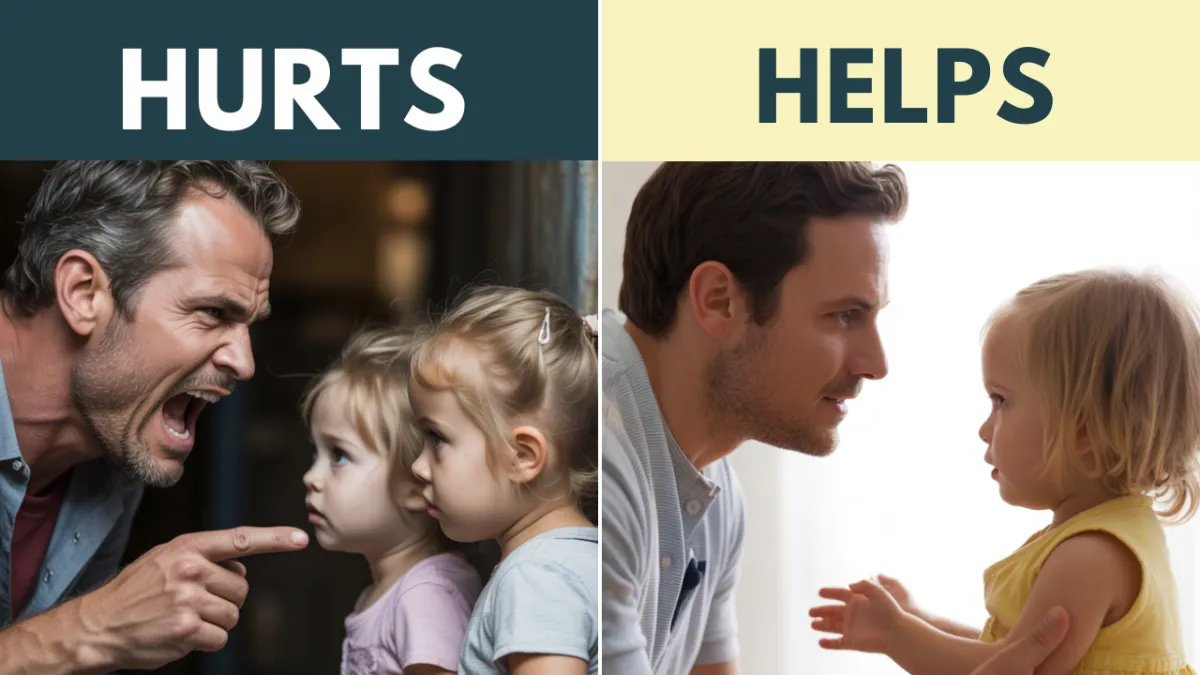
It’s kneeling to your child’s level instead of towering over them.
It’s teaching instead of threatening.
That’s what today’s fathers are learning to embody.
Why Your Physical Presence Matters
Here’s something unique to fatherhood: your physical presence carries weight.
You’re bigger, louder, and often stronger than your kids—and they feel that power intensely, especially when you’re angry.
So here are four cues to monitor closely:
1️⃣ Your Height
Kneel or sit at eye level when correcting behavior. When you stand over a child, even unintentionally, your size becomes intimidating. Guidance gets lost in fear.
2️⃣ Your Voice Volume
Lower it. A quiet, firm voice commands respect more than yelling ever will. When you raise your voice, your child stops listening to your words and starts managing their fear.
3️⃣ Your Tone
Check whether your tone is harsh, sarcastic, or critical. Replace it with one that’s firm but respectful—the same tone you’d use with a colleague who made a mistake.
4️⃣ Your Touch
Physical connection can either calm or frighten. A gentle hand on your child’s shoulder communicates, “I’m here. I’m helping you through this.”
A rough grab communicates fear.
Ask yourself: Is my touch teaching safety, or control?
“Try Again”: The Teaching Consequence
Let’s talk about a strategy that perfectly captures what this new model looks like in action.
It’s called “Try Again.”
Instead of punishing mistakes, you invite your child to correct them immediately—with guidance and connection.
Example 1: The Disrespectful Tone
Your 8-year-old rolls their eyes and mutters, “Whatever, Dad.”
Old model: “Don’t talk to me like that! Go to your room.”
New model: [Kneel to eye level, calm tone]
“Try again. Answer me with respect.”
They adjust: “Okay, I’ll clean it.”
You respond: “Thank you for speaking respectfully, even when you’re upset.”
Example 2: The Sibling Conflict
Your 5-year-old pushes their little sister.
Old model: “How many times do I have to tell you?!”
New model: “Try again. Use gentle hands. Show me how to ask for the toy nicely.”
When they correct themselves, you affirm: “That’s how we treat people in this family.”
Why “Try Again” Works
✅ It teaches instead of punishes.
✅ It’s immediate, not delayed.
✅ It maintains connection, not distance.
✅ It builds confidence and self-control.
✅ It models calm regulation—because you’re practicing it, too.
This is discipline that builds character without shame.
It’s correction through connection.
The Father They’ll Remember
Twenty years from now, how will your children describe you?
Will they say you were strong but kind?
That you taught them without tearing them down?
That they trusted you enough to tell you the truth?
Or will they say they obeyed you—but never felt safe being themselves?
The way you father today shapes your child’s future confidence, emotional health, and even how they’ll parent someday.
The cultural shift is already here.
Fathers around the world are choosing connection over control, teaching over threats, and presence over power plays.
You don’t have to repeat the parenting you received.
You can become the father you needed when you were young.
✨ Ready to Take the Next Step?
If this resonates with you, I’d love to show you the full psychology-backed framework that thousands of parents are using to transform their homes—from reactive to intentional, from chaotic to calm.
Join me for my free Parenting Reset Workshop at
👉 https://drlindsayemmerson.com/reset
This isn’t just for moms.
It’s for every parent who wants to raise emotionally intelligent, respectful, confident kids—without resorting to fear.
Amazing dads, your children are watching.
Show them what real strength looks like.
A calm presence.
A steady hand.
A father they’ll remember with love and respect. 💛


